उत्तर प्रदेश के प्राचीन ऐतिहासिक स्थल: नगर, बौद्ध-जैन परंपरा और कला को अलग-अलग समझें
प्राचीन UP history में answers तब गलत होते हैं जब हर famous place को “धार्मिक स्थल” कहकर छोड़ दिया जाता है। अयोध्या, मथुरा और वाराणसी प्राचीन cities भी हैं; सारनाथ, कुशीनगर और श्रावस्ती Buddhist event-sites हैं; कौशाम्बी ancient Vatsa capital और archaeological centre है; और Jain tradition के लिए Ayodhya, Kashi और Mathura अलग clues देते हैं।
इस article का method है: place → historical tradition/period → exact key event or contribution → present map clue। Current district boundaries map help करती हैं, लेकिन ancient political boundary का substitute नहीं हैं।
पहले तीन groups बनाइए
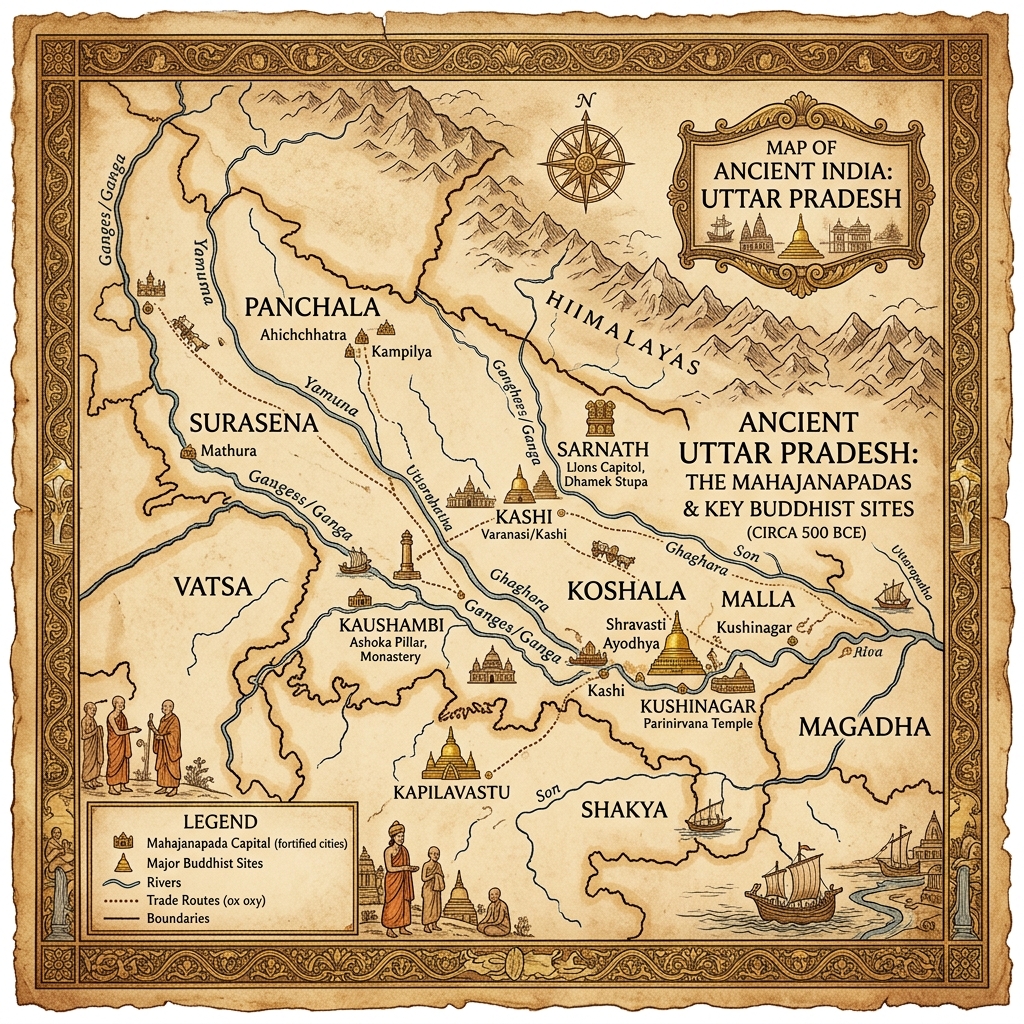
| group | sites | question किस तरह आएगा? |
|---|---|---|
| ancient cities/cultural centres | Ayodhya, Mathura, Varanasi, Kausambi | kingdom, city, art, literature, cultural continuity |
| Buddhist circuit | Sarnath, Kushinagar, Shravasti, Kausambi | Buddha-life event, teaching, monastery/stupa, archaeology |
| Jain associations | Ayodhya, Varanasi, Mathura/region | Tirthankara tradition, ancient religious-cultural context |
एक site two groups में आ सकता है। Kausambi ancient city भी है और Buddhist association भी; Mathura ancient art centre भी है और Jain/Buddhist heritage context भी। Overlap को confusion नहीं, richer answer बनाइए।
अयोध्या: Kosala, Ramayana और Jain tradition
अयोध्या को केवल recent religious-news topic के रूप में न पढ़ें। Ancient history में इसका primary frame Kosala और Ramayana cultural tradition है। Traditional accounts में Ayodhya Kosala की capital मानी जाती है। Question यदि Kosala, Ramayana, Ayodhya या ancient north Indian city पूछे, यह card उपयोगी है।
Jain tradition में भी Ayodhya/Saketa important है और कई Tirthankaras के birth association से जोड़ा जाता है। Basic competitive-exam clue के लिए Rishabhanatha (Adinath) को Ayodhya tradition से जोड़ा जाता है। यदि question exact count या all Tirthankara birthplaces पूछे तो standard Jain history source से final verification करें; broad culture article में unverified long lists नहीं भरें।
| Ayodhya card | answer |
|---|---|
| ancient polity clue | Kosala |
| epic/cultural clue | Ramayana tradition |
| Jain clue | Rishabhanatha/Adinath association in Jain tradition |
| map clue | Ayodhya district, Awadh/eastern-central UP context |
“Awadh” और “Ayodhya” related historical-cultural words हो सकते हैं, पर same modern administrative unit या same period नहीं हैं. Nawabi Awadh article को ancient Kosala answer में copy न करें।
मथुरा: ancient city और art school
Mathura is much more than a devotional city card. Ancient Indian art history में Mathura school of art सबसे important topic है। Kushan period में Mathura sculpture tradition flourished; red spotted sandstone, Buddha/Bodhisattva and Jain images, and indigenous sculptural idiom are frequently cited clues. Exact stylistic comparison with Gandhara अलग art-history chapter में पढ़ें, लेकिन basic distinction याद रखें:
| clue | Mathura direction |
|---|---|
| red spotted sandstone | Mathura school |
| Kushan-period sculpture | Mathura is a major centre |
| Buddha/Jain images in Indian style | Mathura art context |
| Krishna/Braj tradition | Mathura’s cultural-religious context |
Mathura school और Gandhara school दोनों Buddhist art questions में आ सकते हैं, but they are not interchangeable. Gandhara’s Greco-Roman/Hellenistic influence discussion को Mathura card पर न लिखें. Mathura का western UP location and Braj cultural region literary context अलग card है.
वाराणसी/काशी: ancient city, learning और Jain-Buddhist neighbourhood
Varanasi, or Kashi, is a long-continuity ancient city and cultural-learning centre. इसके लिए city-level card रखें—Ganga, Kashi, learning, literature, craft/culture. फिर nearby Sarnath को अलग Buddhist archaeological/event site रखें।
Jain tradition में Varanasi is associated with Parshvanatha, the 23rd Tirthankara, according to traditional accounts. This is a good Jain GK anchor, but do not use it to claim that Sarnath itself is a Jain site. Kashi → Parshvanatha association; Sarnath → Buddha’s first sermon दो अलग cards हैं।
सारनाथ: first sermon और Ashokan heritage
Sarnath Varanasi के निकट एक distinct historical site है। Buddha’s first sermon (Dharmachakra Pravartana) की tradition इससे जुड़ी है। यह clue exam में सबसे high-value है. इसे Mahaparinirvana (Kushinagar) या Jetavana (Shravasti) से बदलना basic mistake है।
Sarnath का दूसरा major clue Mauryan/Ashokan heritage है। Ashoka pillar का lion capital भारत के national emblem का source है, जबकि Dharma Chakra राष्ट्रीय ध्वज के chakra context में आता है। Answer में यह distinction रखें:
| object/context | correct link |
|---|---|
| Buddha’s first sermon | Sarnath |
| Lion Capital/national emblem source | Ashokan pillar at Sarnath |
| Mahaparinirvana | Kushinagar |
| Jetavana | Shravasti |
Dhamek Stupa and other remains Sarnath’s archaeological significance दिखाते हैं। Visitor details या current museum timing dates sensitive हैं; they are not study facts.
कुशीनगर: Mahaparinirvana card
Kushinagar is linked to the Buddha’s Mahaparinirvana. This is one of the clearest place-event pairs in UP GK. It lies in eastern UP/Gorakhpur-side regional context, but question may ask where did Buddha attain Mahaparinirvana? without requiring district/division. Then answer Kushinagar—do not overcomplicate it with Varanasi or Shravasti.
Mahaparinirvana Temple/stupa and reclining Buddha image are heritage cues, but core exam answer stays event-first: Kushinagar → Mahaparinirvana. It is not the place of first sermon, birth or enlightenment; those are different events/locations in wider Buddhist geography.
श्रावस्ती: Kosala, Jetavana और Buddha’s teaching years
Shravasti is remembered as an important city of Kosala and a major Buddhist site. Jetavana monastery is the key anchor, associated with Anathapindika and Buddha’s residence/teachings during many rainy seasons. In objective questions, if Jetavana appears, Shravasti is the answer direction.
| question clue | answer |
|---|---|
| Jetavana | Shravasti |
| Kosala city / Buddhist teaching context | Shravasti |
| first sermon | Sarnath, not Shravasti |
| Mahaparinirvana | Kushinagar, not Shravasti |
Shravasti’s north/eastern UP map context helps, but do not confuse it with modern “Shravasti district” alone. Ancient city, monastery-site and current district are related but different labels.
कौशाम्बी: Vatsa capital और archaeological city
Kausambi (Kaushambi) is one of UP’s most useful ancient city cards. It is associated with the Vatsa Mahajanapada and is traditionally remembered as its capital. Udayana is the Vatsa ruler-name frequently linked to this context. It also has Buddhist associations and archaeological remains, which is why it may appear in both polity and religion questions.
| Kausambi field | revision answer |
|---|---|
| political clue | capital of Vatsa Mahajanapada |
| ruler clue | Udayana (Vatsa tradition) |
| religious/archaeological clue | Buddhist association and ancient urban remains |
| map clue | present Kaushambi/Prayagraj-side context |
Do not write “Kausambi is Sarnath” because both have Buddhist links. One is Vatsa ancient city; the other is first-sermon site near Varanasi.
Jain connections: compact and safe revision
Jain history in UP needs a focused future chapter if the exam syllabus is deep. For UP GK foundation, keep these core associations separate:
| tradition clue | place direction |
|---|---|
| Rishabhanatha/Adinath | Ayodhya tradition |
| Parshvanatha | Varanasi/Kashi tradition |
| ancient Jain sculptures/art | Mathura school/region can appear |
| Tirthankara birth-list | use a standard Jain-history source; do not rely on random quizzes |
This is intentionally not a complete 24-Tirthankara chart. A wrong exhaustive list is worse than a verified foundation. The article’s job is to prevent the common error of treating all ancient UP sites as only Buddhist.
10-place comparison table
| place | primary answer | second clue |
|---|---|---|
| Ayodhya | Kosala/Ramayana | Jain Rishabhanatha association |
| Mathura | ancient art school | Braj/Krishna cultural tradition |
| Varanasi/Kashi | ancient city and learning | Parshvanatha tradition |
| Sarnath | first sermon | Ashokan Lion Capital |
| Kushinagar | Mahaparinirvana | eastern UP Buddhist site |
| Shravasti | Jetavana | Kosala/Buddhist teaching |
| Kausambi | Vatsa capital | Udayana, archaeology/Buddhist context |
30-minute revision drill
- Map only: Ayodhya, Mathura, Varanasi/Sarnath, Kausambi, Shravasti, Kushinagar।
- Event-only: first sermon, Mahaparinirvana, Jetavana, Vatsa capital, Mathura art school।
- Tradition-only: Kosala, Vatsa, Buddhist, Jain, ancient art।
- Reverse recall: each clue से place बोलिए, then place से one clue।
- Wrong answer को tag करें:
Eevent,Pplace,Aart,Ttradition.
Common mistakes
- Sarnath और Varanasi को same site मानना।
- First sermon, Mahaparinirvana और Jetavana को interchange करना।
- Mathura को only a pilgrimage place मानना और art-school context छोड़ना।
- Kausambi की Vatsa capital identity को केवल Buddhist site list में खो देना।
- Jain associations को बिना source पूरी Buddhist list में मिला देना।
- current district/division को ancient kingdom boundary लिखना।
Self-check
- First sermon, Mahaparinirvana, Jetavana—तीनों के places लिखिए।
उत्तर: Sarnath, Kushinagar, Shravasti। - Vatsa capital और associated ruler?
उत्तर: Kausambi; Udayana। - Mathura school का material clue क्या है?
उत्तर: red spotted sandstone। - Sarnath Lion Capital का national significance?
उत्तर: national emblem का source। - Ayodhya को Kosala और Jain tradition से कैसे जोड़ेंगे?
उत्तर: Kosala/Ramayana cultural city; Rishabhanatha association in Jain tradition।
इसके बाद UP history roadmap से chronological sequence देखें, historical heritage guide से monuments compare करें, और जिले और मंडल से present map anchors जोड़ें।
⚠️ यह note परीक्षा तैयारी के लिए है। भर्ती, तारीख या आधिकारिक सूचना के लिए संबंधित विभाग की official website ही अंतिम स्रोत है।